Deepavali: From Naraka Chaturdashi to Tulasi Puja — A Journey from Darkness to Divine Light
Stories, rituals, scriptural traditions, and their meaning across the Deepavali and Kartika season.
Introduction — From Darkness to Light
Deepavali, the row of lamps, is not simply a night of fireworks. Across Hindu communities, it is a season of health, cleansing, justice, prosperity, gratitude, and devotion. The prayer “Tamaso mā jyotirgamaya” (Bṛhadāraṇyaka Upaniṣad 1.3.28) asks to be led from darkness to light. The observances vary by region, family, and sampradaya; no single calendar or narrative describes every household.
How the Festival Spans Fifteen Lunar Tithis
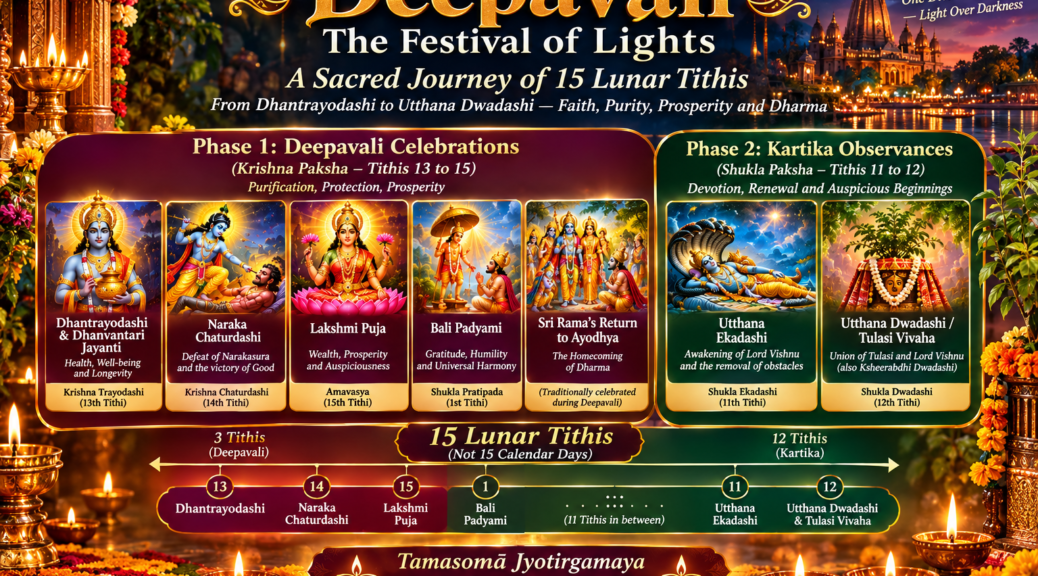
The observances discussed here are not six consecutive days. Counting inclusively from Krishna Paksha Trayodashi (Dhantrayodashi, the 13th waning-moon tithi) through Shukla Paksha Dwadashi (Utthana Dwadashi, the 12th waxing-moon tithi) gives 15 lunar tithis: Trayodashi, Chaturdashi, Amavasya, and the twelve waxing-fortnight tithis from Pratipada through Dwadashi. There are 14 tithi transitions between the starting and ending observances. This does not mean that Deepavali is universally celebrated for fifteen consecutive calendar days. This is a span of fifteen counted tithis, not necessarily exactly fifteen 24-hour calendar days, because a lunar tithi does not always align with a civil day.
Phase one — the principal Deepavali observances: Dhantrayodashi, Naraka Chaturdashi, Amavasya/Lakshmi Puja, and Bali Padyami. Between the phases: Kartika Shukla Dwitiya through Dashami bring additional regional observances and continuing lamp and Tulasi worship; this is not a gap in the lunar calendar. Phase two — the later Kartika observances: Utthana Ekadashi (Shukla Ekadashi) and Utthana Dwadashi/Ksheerabdhi Dwadashi (Shukla Dwadashi), associated with Tulasi Habba in many Karnataka households. Tulasi Vivaha dates vary by region and tradition.
Thus, the article follows a fifteen-tithi arc from preparations for Deepavali to Utthana Dwadashi, while also mentioning later Kartika Purnima as a separate observance beyond that span.
Govatsa Dwadashi — Gratitude for Sustenance
In communities observing Vasu Baras or Govatsa Dwadashi, cows and calves are honored before the main Deepavali festivities. This reflects gratitude for nourishment, agriculture, and the many living beings that support household life. Its contemporary lesson is responsible stewardship rather than treating nature as an inexhaustible resource.
Dhantrayodashi and Dhanvantari Jayanti — Health Before Wealth
Dhanteras is widely associated with acquiring gold, silver, or utensils, but Dhanvantari Jayanti places health at the center of prosperity. In the account of Samudra Manthana (Śrīmad Bhāgavatam 8.8), Dhanvantari emerges with amṛta. In some Karnataka and Iyengar homes, Neeru Thumbuva Habba involves cleaning vessels, preparing water, and invoking Dhanvantari before the next morning’s bath. A customary invocation is: “Om Namo Bhagavate Vāsudevāya Dhanvantaraye Amṛta-kalaśa-hastāya Sarvāmaya-vināśāya Trailokya-nāthāya Śrī Mahāviṣṇave Namaḥ.” Ritual care and prayer should not be confused with medical treatment.
Naraka Chaturdashi — Why Krishna Defeated Narakasura
Śrīmad Bhāgavatam 10.59 describes Bhaumasura (Narakasura) seizing divine possessions and imprisoning royal women. Krishna, accompanied by Satyabhama, defeats the fortress defenses and kills Bhaumasura, then frees the captives. The Bhāgavatam mentions 16,000 women; some other tellings give 16,100. Popular regional retellings emphasize Satyabhama’s decisive role, whereas the Bhāgavatam attributes the killing to Krishna. The story can be read as a warning that strength without dharma becomes oppression. The festival invites us to confront our own arrogance, greed, and indifference, not merely celebrate another person’s defeat.
Abhyanga Snana — The Meaning of the Early-Morning Oil Bath
In many South Indian homes, family members wake before sunrise, receive an oil application, and bathe in water prepared the previous evening. The ritual marks purification and a fresh beginning. In this festive usage, Ganga Snana invokes the sacred presence of the Ganga in the bathing water; it need not mean traveling to bathe physically in the river. “Ganga Snanam Aacha? Ganga Snanam Ayindha? Ganga Snana Aytha?” is a familiar Tamil/Telugu/Kannada greeting asking whether the sacred bath has been completed. Some families chant verses remembering the seven Chiranjeevis: “Aśvatthāmā Balir Vyāso Hanumāṃśca Vibhīṣaṇaḥ, Kṛpaḥ Paraśurāmaśca Saptaite Cirañjīvinaḥ.” Another remembrance names the Panchakanyas: “Ahalyā Draupadī Sītā Tārā Mandodarī Tathā, Pañcakanyāḥ Smarennityaṃ Mahāpātaka-nāśanam.” These are family traditions, not universal requirements. New clothes, sweets, rangoli, and lamps then turn personal renewal into shared joy.
Deepavali Amavasya — Lakshmi Puja and True Prosperity
On the new-moon night, many families worship Mahalakshmi with lamps, flowers, turmeric, kumkum, fruits, and sweets. Prosperity in Hindu thought can encompass nourishment, learning, courage, relationships, and ethical livelihood—not money alone. In northern traditions, Deepavali is also linked to Rama’s return to Ayodhya; in Bengal, Kali Puja is prominent. Jain communities commemorate Mahavira’s nirvana, while Sikhs celebrate Bandi Chhor Divas around this season. These associations deserve recognition without pretending they are identical observances.
Bali Padyami — Mahabali, Vamana, and Surrender
The Vamana narrative (Śrīmad Bhāgavatam 8.18–23) tells how Vishnu asks Mahabali for three steps of land and then manifests as Trivikrama. When no ground remains, Bali offers himself. The account does not end with simple humiliation: Bali receives Sutala and divine protection. In some Karnataka households, Bali is represented with turmeric, grass, and flowers, and offerings may include milk, obbattu, or holige. Family customs differ. The moral is that generosity, keeping one’s word, and humility can outlast worldly authority. Many Gujarati communities also observe their New Year in this period.
Govardhana Puja — Protecting What Sustains Us
Śrīmad Bhāgavatam 10.24–25 recounts Krishna encouraging the people of Vraja to honor Govardhana, cattle, and their way of life. When Indra sends destructive rain, Krishna protects the community beneath the lifted hill. The narrative addresses pride, divine protection, and gratitude toward the natural environment.
Yama Dwitiya — The Bonds of Family
Bhai Dooj or Yama Dwitiya celebrates the bond between siblings, traditionally associated with Yama and Yamuna. Through hospitality, blessings, and mutual care, the festive cycle turns outward from personal purification toward relationships and responsibility.
Kartika Masa — Why the Lamps Continue
Deepavali’s main days conclude, but Kartika observances continue. Month names depend on the calendar: in amanta reckoning, the waning tithis before this new moon belong to Ashvija and Kartika begins at Shukla Pratipada; in purnimanta reckoning, the preceding waning fortnight is already Kartika. Families may light lamps, worship Vishnu or Shiva according to their traditions, and offer daily prayers at the Tulasi Brindavana. Tulasi worship is not simply another name for Deepavali: it has a distinct place in Vaishnava devotional practice.
Utthana Ekadashi — Awakening from Yoga Nidra
Prabodhini or Utthana Ekadashi commemorates Vishnu’s awakening from the cosmic repose associated with Chaturmasya. Yoga Nidra here is a religious image, not ordinary sleep. It marks renewed auspicious activity in many communities and invites an inner question: are we awake to the consequences of our choices, or merely following habit?
Utthana Dwadashi / Ksheerabdhi Dwadashi — Tulasi Habba
In many Karnataka Vaishnava households, Kartika Shukla Dwadashi is celebrated as Utthana Dwadashi or Ksheerabdhi Dwadashi. “Ksheerabdhi” refers to the Ocean of Milk associated with Vishnu. The Tulasi Brindavana is cleaned and decorated with rangoli, lamps, flowers, and seasonal offerings. The ceremonial marriage of Tulasi and Vishnu—often represented by Shaligrama or Krishna—may be performed with wedding-like prayers and offerings. Other communities observe Tulasi Vivaha on dates between Prabodhini Ekadashi and Kartika Purnima; consult the local Panchanga and family tradition.
Who Is Tulasi? Vrinda, Jalandhara, and the Complexity of Tradition
Tulasi is revered as a sacred plant and as Tulasi Devi, especially in Vaishnava worship. Puranic accounts link her with Vrinda and Jalandhara, while other narratives involve Tulasi and Shankhachuda. Versions differ, including difficult ethical elements concerning disguise, fidelity, and divine intervention. Rather than flattening these into a single story, we can acknowledge textual variation and approach them thoughtfully. Tulasi Vivaha celebrates her devotional association with Vishnu; daily care for the living plant also makes reverence part of ordinary household life.
Kartika Purnima — The Full-Moon Culmination
Kartika Purnima is observed with lamps, temple worship, and other regional practices. In Varanasi, Dev Deepavali is associated with this period; some Shaiva traditions celebrate Tripurari Purnima. The journey from the dark new moon to the bright full moon provides a memorable image of increasing illumination.
What Should We Carry Beyond the Festival?
Dhanvantari teaches care for health; Naraka Chaturdashi challenges the abuse of power; Lakshmi Puja calls for responsible prosperity; Bali Padyami honors humility; Govardhana Puja recalls our dependence on nature; and Tulasi worship places devotion within daily life. Our ancestors passed down rituals through family practice. We honor that inheritance most meaningfully when we also explain it to the next generation, distinguish scripture from regional custom, and allow thoughtful questions.
Conclusion — Let the Light Remain
A lamp is meaningful not only because it burns on a festival night but because it reminds us how to live afterward. May we replace ignorance with learning, pride with humility, neglect with gratitude, and indifference with compassion. Tamaso mā jyotirgamaya. Wishing everyone a blessed Deepavali and Kartika Masa. — Dr. S2M2 | GnanaSurabhi
Scriptural References
- Bṛhadāraṇyaka Upaniṣad 1.3.28 — Pavamana prayer.
- Śrīmad Bhāgavatam 8.8 — Dhanvantari and Samudra Manthana.
- Śrīmad Bhāgavatam 10.59 — Bhaumasura and the liberated captives.
- Viṣṇu Purāṇa 5.29 — Another Bhaumasura account.
- Śrīmad Bhāgavatam 8.18–23 — Vamana and Mahabali.
- Śrīmad Bhāgavatam 10.24–25 — Govardhana.
- Śiva Purāṇa, Rudra Saṃhitā, Yuddha Khaṇḍa — Jalandhara and Vrinda traditions.
- Devī Bhāgavata Purāṇa, Book 9 — Tulasi traditions (chapter numbering varies by edition).
Editorial note: Puranic narratives, regional practices, and modern philosophical reflections are distinguished throughout. Dates vary by geography and Panchanga.